
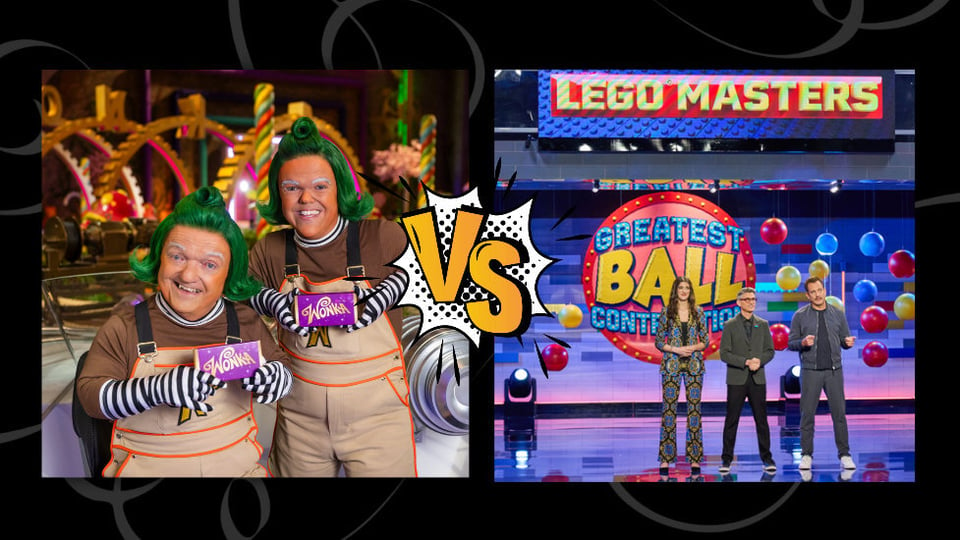
Appealing to families’ nostalgia for a beloved 1970s fantasy musical, Netflix recently rolled out Wonka’s The Golden Ticket, reimagining elaborate movie sets and life-lesson challenges as a winner-take-all reality show.
Meanwhile, brick-building series Lego Masters, whose sixth season is slated for Fox’s midseason lineup, has become a years-long co-viewing tradition for many families.
Which TV reality-competition journey is worth taking with your kids? We’ll compare format, spectacle, content concerns, and the messages young viewers take away.
Spoiler alert: Looks like our family budget for Lego bricks will increase this Christmas.
Two unique takes on reality competition
Known for Matilda and The Witches, Roald Dahl wrote about hardscrabble children mistreated by adults. That includes Charlie Bucket, hero of his 1964 novel Charlie and the Chocolate Factory.
Dahl’s legacy is complicated. The book’s original Oompa Loompas drew criticism for racist depictions, prompting revisions; his antisemitic remarks also drew condemnation. More recent edits to his books sparked a separate debate over censorship and sensitivity.
The 1971 film Willy Wonka & the Chocolate Factory, starring Gene Wilder, became a sleeper hit, balancing spectacle, humor and a kid’s-eye warning against greed, gluttony, and a screen-obsessed childhood.
After buying the Roald Dahl Story Company in 2021, Netflix has sought to revive his creations. Wonka’s The Golden Ticket brings 12 two-person teams into a recreated chocolate factory for physical, puzzle-solving and character tests that eliminate contestants.
Lego Masters, whose U.S. edition premiered in early 2020, likewise puts pairs under pressure. They face increasingly demanding creative challenges, racing against the clock to turn ordinary plastic bricks into extraordinary constructions.
Spectacle and mass appeal — Winner: Wonka
The first episodes of Wonka absolutely wow fans of the classic film, capturing its aesthetics, appeal and human drama. Multiple enormous sets include the Chocolate Room, where grass, trees, and every visible flower or bauble are edible.
Rusty Goffe, an Oompa Loompa from the 1971 movie, reprises his role. “Pure Imagination” and “The Candy Man” accompany montages. More controversially, an AI recreation of Wilder’s voice narrates the proceedings, with permission from his estate.
Clever editing introduces teams recalling the original story: a young woman styled like Veruca Salt and her indulgent father, plus influencers, whom viewers can hardly wait to see get their comeuppance. The prize? A “lifetime supply of money”: $3 million paid over 30 years.
In contrast, the tightly produced Lego Masters, guided by executive producer Anthony Dominici and director Rich Kim, might initially seem underwhelming. After all, its focus is plastic bricks scattered across family floors.
Yet the pacing, team dynamics and inventive challenges — from demolition derbies to Star Wars planets — consistently make terrific television. Contestants compete for $100,000, while direct-to-camera confessionals give viewers insight into each team’s ambitions and anxieties.
Family-friendly content — Slight edge: Lego Masters
Practical effects make Wonka’s early challenges delightful. A hallway appears to shrink as contestants walk through it; elsewhere, players seem encased in giant gumballs. Kids will smile and wonder what’s real.
We also glimpse the values that made the original beloved. One woman sacrifices her chance to help others advance, later returning with an advantage that keeps her and her father in contention. Challenges test brains, brawn and character.
Unfortunately, some language undercuts the sweetness. Contestants repeatedly exclaim “OMG” (not the acronym), while the occasional “d*mn” and other phrases slip through. Near the finale, a dating couple appears to wake up in the same bed, though fully clothed.
Early Lego Masters seasons likewise feature occasional misuse of God’s name or salty expressions when a massive build collapses after hours of work. Later seasons seem to have cleaned up that language, recognizing their young audience.
What young viewers take away — Winner: Lego Masters
As a fan of Wilder’s Wonka and shows like The Amazing Race, I enjoyed much of Netflix’s competition. Players push physical limits, solve complicated puzzles, and shed real tears when they must leave.
But eventually Wonka embraces an “outwit, outplay, outlast” mentality, where relationships become collateral damage in the quest for money. Several mean, selfish charlatans get exposed, yet the winner — and runner-up — hardly display the innocence or sincerity rewarded in Dahl’s story.
A candy-coated assortment of put-downs, aggressive talk (“go for the head”) and a dollop of misogyny leave a sour aftertaste. The two-part finale abandons the visual wonder of earlier challenges, almost as if the budget ran out and producers substituted catty drama.
For Lego Masters, seasons two through four arguably represent the sweet spot. Challenges become harder, builds more meticulous and competitors regularly lament when another team loses. The show rewards ingenuity without treating kindness as weakness.
Season five grows more commercial, with seemingly endless branded challenges involving franchises like Batman and Wicked. Nick Cannon will replace Will Arnett for season six; whether he’ll preserve Arnett’s gentle, self-effacing humor remains to be seen.
Ultimately, Lego Masters celebrates artistic expression, collaborative problem-solving and intergenerational bonding through play. Definitely give it a try. And if you sample Wonka, be warned: The sweetness doesn’t last.
Both shows are rated TV-PG. Wonka’s The Golden Ticket streams on Netflix; Lego Masters airs on Fox, and also streams on Hulu and Disney+ in the U.S.
Photo: (left) Wonka's The Golden Ticket (Netflix); (right) Lego Masters (Fox)
Freelance journalist Josh Shepherd writes on faith and culture for several media outlets. He and his family live in central Florida.
More Like This:
'Wild Kingdom' Returns: A Family Adventure Worth Passing Down
AfterSchool Specials: 6 Standout Kids’ Shows to Stream
'Fork in the Road': EWTN+ Series Blends Food, Family, Faith & Travel
Keep up with Family Theater Productions our website, X, Instagram and YouTube.