
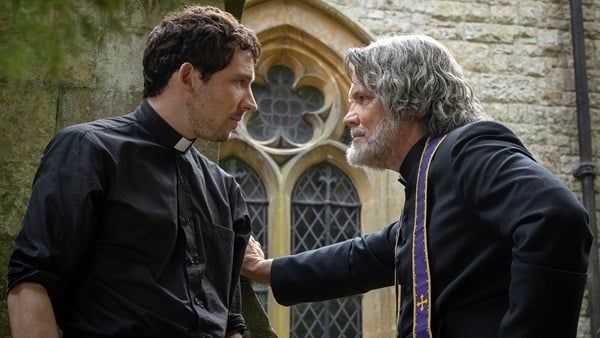
Wake Up Dead Man: A Knives Out Mystery, currently on Netflix after a theatrical run, represents a cinematic risk, in which a filmmaker that is not part of a specific subculture sets out to make a movie set in the heart of it.
In this case, it's writer/producer, director Rian Johnson, who grew up as a self-described Protestant Evangelical.
Johnson moved away from the Christianity of his youth, but Wake Up Dead Man -- the third of his Knives Out mystery movies -- is set in a small Catholic parish in Upstate New York (it was actually filmed at an Anglican church in the U.K.), and focuses on two very different priests (SPOILERS AHEAD, but none that weren't already in the teaser trailer).
What Is Wake Up Dead Man About?
Newcomer Father Jud (Josh O'Connor) is young and on fire with his faith -- but his tragic past as a boxer still haunts him. The other is Monsignor Wicks (Josh Brolin), pastor of the parish, whose overbearing, dictatorial style holds some parishioners in thrall and drives others away.
When Monsignor Wicks is murdered -- in classic Agatha Christie style -- Father Jud falls under suspicion. In comes dapper detective Benoit Blanc (Daniel Craig), a vocal nonbeliever, to unravel the knotty dilemma.
Also starring are Glenn Close, Thomas Haden Church, Mila Kunis, Kerry Washington, Jeremy Renner, Andrew Scott (who himself played a priest in the series Fleabag), and Cailee Spaeny.
NOTE: The film is rated PG-13 for violent content, bloody images, strong language, some crude sexual material, and smoking. While not quite to the level of an R rating, parents are strongly cautioned. Wake Up Dead Man is NOT for the whole family.
Here's the official teaser (mild profanity warning):
A Pivotal Scene, From Rian Johnson's Perspective
In one scene, Father Jud is in the middle of dramatic goings-on when a local person he called suddenly changes direction in the conversation and asks for his counsel.
As Johnson told RogerEbert.com:
It’s a huge turning point for Jud, and it’s also the thesis of the whole movie. Jud is a priest who genuinely wants to bring Christ’s love to people. He wants to be selfless; he wants to serve. He ends up in the middle of a murder mystery movie. ...
Just as we, as an audience, get swept up in this, Jud gets very swept up in it. Then there is this moment when he is reminded that he is a priest, and this game is antithetical to what he is set on this Earth to do.
This scene, and others like it, have caught the attention of several Catholic commentators, who generally have given the film positive reviews for its realistic (within the confines of a mystery movie) portrayal of the priesthood.
Checking In With FTP's In-House Priests
So, I turned for reactions to the two Holy Cross priests at Family Theater Productions: National Director Father David Guffey, C.S.C., and producer-at-large Father Vince Kuna, C.S.C., a frequent contributor to this blog.
Both also have filmmaking degrees -- Father Guffey, from Loyola Marymount University, and Father Vince (as we call him in the blog), from the USC School of Cinematic Arts -- and both have consulted on film and TV productions.
Currently, Father Guffey is an ongoing consultant on the hit Gospels-based Prime Video series The Chosen, and participates in the show's Bible Roundtables.
Below find my questions and their answers.
What aspect of the priesthood did this film get the most right?
Father Guffey: No priest or any other person for that matter is without sin. Fr. Jud’s sin, with grace and his repentance, becomes part of his pastoral strength, in preaching Christ to imperfect people, believing that God can work in their lives.
When you are a priest, any conversation can turn into a moment of ministry. There is a scene in which Fr. Jud calls an office for information and at the end of the conversation, the woman reveals she needs to talk about something she is going through.
The young priest stops what he is doing and listens to her. When you are a priest, you never know when this sort of thing may happen. At first this sort of interaction feels like an interruption to my work, then I remind myself that those conversations are my work.
Father Vince: The differing personalities were organic to the setting in a Catholic parish. Quite simply, a typical day at the parish will see a Catholic priest ministering to all walks of life of every single demographic imaginable.
I might be celebrating a funeral for a multi-millionaire, casual Catholic in the morning, then anointing a poor, yet devout Catholic in the middle of the night.
Which aspect did it miss most on?
Father Guffey: The older Monsignor, in our times, would not have been able to get away with the extreme behaviors he showed. He would have been called in by the diocese or by lawyers or both.
If a diocese had any sense of the harsh and complicated personality of the older priest, they would not send someone newly ordained to observe or clean it up.
Father Vince: I don’t remember seeing the priest engage in any leisure activities outside his religious duties. Granted, there’s only so much the film can depict in two hours, but in a mystery film, part of the genre is to include scenes that purposefully throw off the viewer.
The exclusion of scenes to show the priest as more well-rounded seemed odd.
What was your reaction to the character of the Monsignor?
Father Guffey: He represents extremes in a few ways.
First, he appears to be old school in his emphasis on judgement and sin. This, of course, is a kind of projection, as he is not dealing with his own inner darkness. This is what happens when there is a lack of humble self-knowledge and the awareness of our own need for ongoing conversion and repentance.
Second, he represents the extreme of priests who form a kind of cult of personality around themselves, surrounded by devotees who dote on the priest, affirming without challenge, relating to the priest more than the parish, diocese, universal church or even the Gospel.
In recent years, versions of this kind of priest pops up on both the traditional and progressive side. They often place themselves and their views above their bishops, religious superiors or even the pope himself.
Father Vince: I thought he was the one character who was slightly caricatured.
If you were to counsel Father Jud, what would you tell him?
Father Guffey: Keep faithful to the Gospel and treasure the gift you have been given in your call to serve as a priest. Find a wise and experienced spiritual director to help you listen to God’s call and connect what happens to you in life and in pastoral ministry with the presence of God in our midst.
Even if you feel like you fail, keep trying to be Christlike for people you serve.
Father Vince: Once more and into the breach, good sir. The priesthood isn’t easy. Father Jud learns this through the course of the film.
What does it mean for a non-Catholic (and no longer Christian) director like Rian Johnson to take the time and effort to research Catholicism?
Father Guffey: I am grateful that he did so. If you were doing a film about any group -- ethnic or religious -- you would need to respectfully make an attempt to understand the culture and not just rely on stereotypes or caricatures.
Would you make a film about the Apache or Haitian people, without learning their culture or history relevant to the story?
Regarding Catholicism, it seems that he did so and in doing that he honored the grace and sin present in the people and parish, but respecting the culture of the wider group.
Father Vince: The Knives Out films served as popcorn entertainment for me…easily forgettable. With Wake Up Dead Man, the search for objective truth is germane to both crime-solving and Catholicism, so if one is set in the cultural milieu of the other, you might as well get both right.
What would your message be to future filmmakers who want to use Catholicism as an element in their storytelling?
Father Guffey: Make an effort to know what the symbols, rituals, and structures really are, and what they mean to the people in Catholicism.
If you are using Catholic visuals without a sense of their meaning, they are empty onscreen. It becomes a crass appropriation of something that means something sacred to millions of people.
Father Vince: If Catholicism is an unseen, thematic element buried in the subtext, then don’t “think” about how to Catholicize the story, just tell the truth of the story.
As I often tell students, something isn’t true because it’s Catholic, it’s Catholic because it’s true.
If Rian Johnson could make a popular, mainstream film that also hit well with Catholic viewers, what message does that send to Catholic filmmakers?
Father Guffey: If in a mainstream film, you really want to explore faith, with the possibility of showing authentic grace and spiritual transformation, you must be willing to acknowledge the depth and power of sin and not avoid conflict or the possibility that sin might prevail in some circumstances.
Wake Up Dead Man is not catechism and has adult content. We need to trust that Catholic adults can see through that to the possibility of deeper meaning.
Father Vince: As easy as it is to dismiss an artist for professional failures or personal indiscretions, always give them a second chance. Heck, give them seven times 77 chances. Had I written Rian off after the Star Wars sequels or the first two Knives Out offerings, I would have missed this hidden gem.
So, like the young priest in the movie, stay at it.
Image: John Wilson/Netflix © 2025
Rev. David L. Guffey, C.S.C., serves as National Director and Head of Production at Family Theater Productions.
Click here to visit Father Vince Kuna’s IMDB page.
Kate O’Hare, a longtime entertainment journalist, is Social Media Content Manager and Blog Editor at Family Theater Productions.
PRAY: THE STORY OF PATRICK PEYTON Comes to EWTN
Minno Streaming: 7 Standout Faith-and-Learning TV Series for Kids
New Year’s Resolutions From Classic Comfort Movies & TV
What We Watch on a Winter's Night: Our Favorite Holiday Viewing
Keep up with Family Theater Productions on our website, Facebook, X, Instagram and YouTube.