
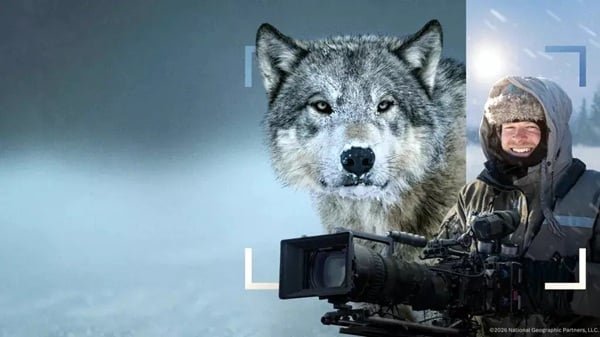
There are few wildlife filmmakers who can bring audiences closer to the natural world than National Geographic Explorer Bertie Gregory.
Whether he's swimming alongside sharks, tracking elusive big cats or venturing into some of the planet's most unforgiving environments, Gregory has a gift for making extraordinary animal behavior feel immediate, personal and wonderfully accessible.
Gregory and the Wolf Pack
His latest adventure, Wolves Up Close With Bertie Gregory, takes Gregory back to the Canadian Arctic, where he reconnects with a wolf pack he has followed for seven years. The result is a fascinating look at the intelligence, cooperation and remarkable survival instincts of wolves, with a few unexpected lessons for viewers of all ages.
And parents, here's something worth knowing before you tune in: While the documentary follows real predator-prey encounters and includes the natural tension of the hunt, it does not rely on ultra-violent imagery or graphic, visceral kill scenes.
The emphasis is on observing and understanding wildlife, not sensationalizing the realities of nature. Some sequences may be intense for very young or especially sensitive viewers, but this is an educational wildlife adventure rather than a graphic nature exposé.
Seven Years, One Wolf, and an Extraordinary Reunion
Gregory returns to a familiar stretch of Arctic wilderness to reconnect with a wolf pack he has followed for seven years, led by Kona, a striking white breeding male. After years of observing these animals, he has developed an unusually intimate understanding of their personalities, relationships and changing circumstances.
But would Kona still be there?
During our exclusive conversation, I asked Gregory whether he felt confident he would eventually find the wolf again after such a long journey across an enormous and challenging landscape.
"I thought there was a pretty good chance," Gregory told me. "But, you know, nothing in nature is guaranteed."
The expedition meant traveling halfway around the world to a very specific location, not simply to film wolves, but to find an individual pack and reconnect with a particular animal. Even if Kona was still alive, locating him was another matter entirely.
"Their territories can be hundreds of square kilometers, hundreds of square miles," Gregory explained.
And the Arctic wasn't cooperating. Warmer-than-expected conditions meant rivers that the crew needed to cross repeatedly throughout the day weren't frozen. Instead of providing dependable passage across the landscape, they became obstacles, leaving the team struggling to cover the ground necessary to find the pack.
"We were really struggling to travel because it was a lot warmer than we expected," he recalled. "The rivers that we needed to cross regularly per day, 10 times a day, we'd cross rivers. They weren't frozen, so we were getting stuck."
It was a reminder that wildlife filmmaking requires patience, persistence and a willingness to accept that nature operates on its own schedule.
After all the miles, setbacks and uncertainty, the team finally found what they had traveled so far to see.
"I'm just grateful that eventually, after, you know, pounding the pavement enough, we eventually came good," Gregory said.
That reunion gives Wolves Up Close With Bertie Gregory an especially personal dimension. This isn't simply a filmmaker encountering an animal in the wild. It's the continuation of a seven-year story, with all the uncertainty and extraordinary rewards that come with following wildlife on its own terms.
And now, viewers get to share in that journey.
Why Moose? Understanding the Wolves' Fight for Survival
But reconnecting with Kona is only the beginning. Winter in the Canadian Arctic is unforgiving. Food becomes increasingly scarce, an encroaching rival wolf threatens the pack's territory, and the aging leader faces challenges that could affect the group's future.
The pack's biggest challenge? Finding enough food to survive.
That brings us to one of the documentary's most compelling storylines: the wolves' pursuit of bull moose, enormous animals that can weigh roughly ten times as much as an individual wolf.
Why moose? In this harsh environment, a large animal can provide an enormous amount of food for a hungry pack. But taking down prey of that size is anything but easy. Wolves must work together, use patience and strategy, assess their opportunities and conserve energy. It's a remarkable demonstration of cooperation and survival instincts in the wild.
Rather than simply showing viewers a hunt, Gregory gives us a closer understanding of how wolves operate as a social group, communicate, make decisions and depend on one another.
An Arctic Adventure Beyond the Wolves
The special also broadens its view of Arctic life with appearances by polar bears, a wolverine and a river otter hunting beneath the ice.
Gregory is joined by Swampy Cree First Nations elder Albert "Butch" Saunders and veteran wildlife guide Mike Reimer, whose knowledge helps place the animals and their habitat within a much larger story about people, wildlife and the land.
The Arctic itself is changing, too. A warming Hudson Bay is delaying the annual freeze-up, creating additional challenges for animals that depend on the seasonal rhythms of this frozen landscape.
There's also an intriguing story involving a lone black wolf that ventures close to Kona's territory. In our conversation, Gregory discusses a wolf previously encountered in his National Geographic work and the relocation effort he was involved with, adding another perspective on the complicated relationship between wildlife, territory and human intervention.
It's a reminder that wildlife filmmaking isn't simply about pointing a camera at an animal and waiting for something extraordinary to happen. It can involve years of observation, difficult decisions, careful planning and a deep respect for the creatures being documented.
Why Families Should Watch
One of the things I particularly appreciate about Gregory's work is the way he makes science and animal behavior entertaining without losing sight of the educational value.
Wolves are often misunderstood. Popular culture has given them a reputation that doesn't always reflect the complexity of their lives in the wild. Here, viewers get to see the importance of pack relationships, cooperative hunting, leadership and the delicate balance that allows wildlife to survive in an unforgiving environment.
There are also plenty of opportunities for younger viewers to ask questions. Why do wolves hunt together? How do they decide which prey to pursue? What happens when a new wolf enters another pack's territory? How do animals adapt when their environment changes?
And perhaps most importantly, how can people better understand and coexist with wildlife?
Parents looking for something different from the usual entertainment lineup will find plenty to appreciate. The documentary offers real adventure, spectacular Arctic scenery and a front-row seat to animal behavior that few of us will ever witness firsthand.
While the hunting sequences have natural suspense, families won't encounter gratuitous ultra-violent imagery or graphic, visceral kill scenes. It's a thoughtful distinction for parents considering wildlife programming for younger viewers. As always, a parent's familiarity with a child's sensitivity to predator-prey scenes is the best guide.
My recommendation: Put this one on the family viewing list. Wolves Up Close With Bertie Gregory offers a fascinating opportunity to learn about one of nature's most misunderstood animals while experiencing the excitement of a true Arctic expedition.
It's suspenseful, educational and ultimately respectful of the natural world. It's also a wonderful reminder that sometimes the most compelling stories aren't written by Hollywood. They're happening right outside our window, in the wild.
When and Where to Watch
Wolves Up Close With Bertie Gregory premieres Friday, November 6, 2026, at 9 p.m. ET/PT (8 p.m. CT) on National Geographic.
The special is also available to stream November 6 on Disney+ and Hulu. National Geographic WILD will air the program Saturday, November 7.
For families who enjoy nature documentaries, wildlife adventures and extraordinary real-life storytelling, this is one worth making time for.
Image: National Geographic/Disney+
April Neale is a mother of two and grandmother of five. She is a career journalist whose articles have been published in national and international publications. She is a longtime member of the Critics Choice and Television Critics Association.
More Like This:
'Wild Kingdom' Returns: A Family Adventure Worth Passing Down
The Great 8: Nature & Wildlife Series the Whole Family Can Explore Together
NatGeo's 'Lion' Roars With Family, Courage, and (Wild)Life Lessons
Keep up with Family Theater Productions our website, X, Instagram and YouTube.