
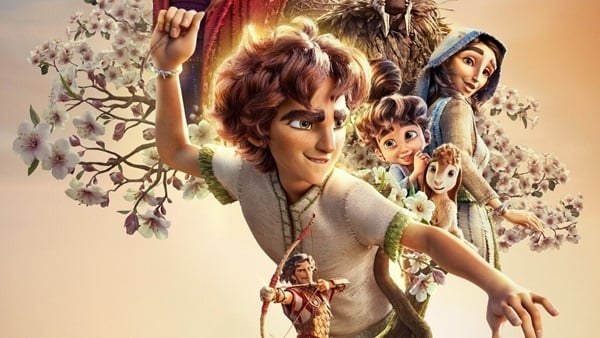
A big-budget animated musical adaptation of the iconic Old Testament story, David arrives in theaters on Dec. 19 — one month after lavish musical Wicked: For Good broke box-office records. Both rated PG, each movie reflects the work of hundreds of artists, but they differ starkly.
Not a Revisionist Tale but Biblical
Unlike Wicked: For Good, which is based on a stage musical based on a novel loosely inspired by (and radically altering the meaning of) L. Frank Baum's Oz books, David's source material comes right from the Bible (plus some songs).
The upcoming biblical epic introduces shepherd boy David (Brandon Engman), protecting sheep in the hills of Bethlehem, then facing off against Goliath. Leaping ahead years, David, voiced as a man by music star Phil Wickham, wrestles with God’s call to become king of Israel as he evades tormented King Saul.
Far afield from any typical Hollywood film, David came about through millions in crowdfunding and a unique partnership between Utah-based Angel Studios, and lesser-known Sunrise Animation Studios, based in South Africa.
David co-director Phil Cunningham, also president of Sunrise, led the sprawling production — which involved more than 400 artists in 32 different countries — from their offices in Cape Town.
“We’re just this small production studio at the southern tip of Africa,” Cunningham told me in an interview. “But there's a beautiful verse that says, ‘Not by might, nor by power, but by my spirit, says the Lord.’ I think God chose this team to tell this story, so that he gets the glory.”
Screenwriter and co-director Brent Dawes drafted a first David script in 2014, which underwent ten iterations over the next decade. In recent years, Pixar veteran Nathan Stanton, twin brother of Oscar-winner Andrew Stanton, came on board as David’s head of story and assistant director.
“Whenever we hit a story block, we always found that going back to Scripture was the answer,” said Dawes. “We really tried to keep the essence of what we feel the text was saying, even if it's not 100% portrayed.”
Producer Rita Mbanga, who has worked on Cunningham’s team for decades, notes that COVID was among several difficulties they faced. “Making this movie was a real David and Goliath story, right? We’ve faced so many challenges over the past 11 years.”
From concert stage to big screen
One early hurdle was finding their David.
“What we found is that actors often can't sing very well. And singers often can't act with any sort of range,” noted Cunningham.
Wickham, who recently led millions in worship at the Charlie Kirk memorial event, proved to possess the rarity of both singing and acting talent — the latter helped along by a coach.
The film director says that landing one of the biggest stars in contemporary Christian music was “far from a gimmick.”
“He worked hard in multiple auditions, and every day since,” said Cunningham. “Actually, bringing the acting elements into the singing ended up being the most challenging aspect.”
A cinematic musical with 10 original songs was new for Wickham. Hollywood composer Joseph Trapense (The Greatest Showman) crafted the score, collaborating with Nashville-based Grammy winner and producer Jason Halbert, who recruited lyricists and collaborated on songs.
Working remotely from multiple studios, Cunningham recounts the direction given on “My God/Why God,” a critical duet performed with David’s mother Nitzevet (Miri Mesika), as David flees Saul. Wickham’s usual bent toward pitch-perfect performance wouldn’t fly.
“In this instance, we want it to be broken,” Cunningham recalled telling their lead. “You're in tears and your emotions are getting the better of you. It's not a beautiful song at that moment.”
Ultimately, Wickham and Mesika nailed the emotion.
Weeks later, composer Trapense matched those vocal tracks, as he conducted an 80-piece orchestra at AIR Studios in London. He and producers spent two weeks perfecting the music, which included a 24-voice choir.
“Watching Joe conduct, you saw him come alive on that stage,” said producer Mbanga.
Crafting songs in character
From the start, screenwriter Dawes sought to avoid musical tropes — either the tendency to break into song, aka Wicked, or the style of Disney's pop-music Tarzan, where it’s less character-driven.
“So often in musicals," said Dawes, "it's like, Why are you singing? But David is introduced as singing to his sheep, and our film has a story reason for every song. And when there’s a song, he’s singing.”
Lyricists contributed varied expertise, with Grammy Award-winner Jonas Myrin capturing David’s boyish energy. Messianic Jewish singer Marty Goetz and his daughter. Misha Hoyt, ensured translated Hebrew carried authenticity.
Dawes recalled how married musical duo Molly Kate Kestner and Brock Monroe, who wrote multiple songs for David, visited Cape Town. One evening, several animators joined the couple around the studio’s downstairs fireplace.
“They were just flowing and writing what became ‘Shalom,’” said Dawes. “The people with them couldn't believe what they witnessed, because the animators never get to be a part of that. It became such a pivotal song, where David speaks peace to Saul.”
Another Grammy winner, chart-topping singer Lauren Daigle, has a minor role in the film and duets with young David on “Shalom,” with brief cameos in two other musical moments.
Despite the songs originating from 10 different writers across the globe over multiple years, the end result has remarkable sonic and thematic cohesion — particularly the imagery of light.
The first song opens with the line: “There's a light in the distance.” A key mid-film single, “Follow the Light,” begins with, “There's a light I've always followed.” And the musical’s finale has the first line: “The Lord is my light.”
“There's a journey there that I didn't craft,” said Dawes. “It just naturally happened; God breathed on it, I guess. It makes a statement of what this film is about, and I just love it.”
The David soundtrack was just released, available on Spotify and all major platforms.
More to the story
Getting the music right involved more than creative writers — they consulted theologians, too.
Rabbi Tuly Weisz, a respected Jewish educator, reviewed many aspects of David for accuracy. Producer Rita Mbanga recalls how they would email him draft lyrics and scratch-track versions of songs.
“We’d tell him, ‘Our songwriters want these phrases from Psalm 127 in Hebrew, is this correct?’” she said. “Rabbi Tuly would email back, ‘Well, the literal translation is close. But if they were singing it at the time, they would probably voice it this way.’”
The care brought to David involved the work of hundreds of animators, artists, producers, technical advisors, a dozen other voice actors, and many more . . . all to recount the story of the shepherd king as never before.
Watch for our upcoming review of David, opening in theaters on December 19, and a second part of this feature, with details of the team’s research trips to the Holy Land, their wrestling with certain story choices, and more behind-the-scenes stories.
Image: Angel Studios
Freelance journalist Josh Shepherd writes on faith and culture for several media outlets. He and his family live in central Florida.
'Hospitality in Action: Serving With Heart' ... and Biscuits
'Wicked: For Good': But, Is It?
7 of the Absolute Best Family-Movie DVD & Blu-ray Sets
'Toy Story' at 30: The Toys Are Plastic, But the Love Is Real
Keep up with Family Theater Productions on our website, Facebook, X, Instagram and YouTube.