
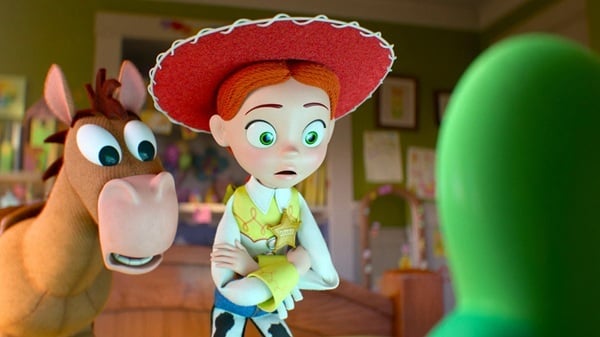
In 1995, the tale of a toy fearing he was forgotten became a global hit. But with its fourth sequel delivering this year’s highest box-office opening, blockbuster family franchise Toy Story may actually outlive us all.
Currently in theaters, this fifth installment, helmed by master storyteller Andrew Stanton (Finding Nemo, WALL-E) and co-director Kenna Harris, tells a satisfying toys-versus-tech yarn, even as it runs through similar paces our plastic protagonists have seen before.
Toy Story 5 Heads in a Different Direction
Toy Story 5 wisely course-corrects, after its predecessor occasionally veered into horror-lite. Inside jokes for parents can be fun, but nods to The Shining and The Exorcist in the fourth film went a bit far.
This time out, laughs, friendship and a few teary-eyed scenes drive the adventure, with Joan Cusack voicing cowgirl Jessie, newly minted sheriff of Bonnie’s bedroom, taking the lead.
Buzz (Tim Allen) and Woody (Tom Hanks) trade barbs as part of the ensemble, while three outdated-tech toys, voiced by Conan O’Brien, Craig Robinson, and Shelby Rabara, keep the comedy fresh.
The big addition is Lilypad (Greta Lee), a network-enabled tablet full of mindless games that prove irresistible to third-grader Bonnie (Scarlett Spears).
My wife and I have children entering kindergarten and second grade, so we're already navigating these questions ourselves. In fact, a main weakness of Toy Story 5 isn’t any coarse language or potty humor (though it has a bit of the latter), but its blunted critique of children’s internet-enabled tech devices.
Pull-Strings and Heartstrings
The premise of Toy Story 5 wouldn’t amount to much in most filmmakers’ hands: Jessie and the gang are forgotten by their young charge when she gets a colorful new tablet.
But Pixar’s Stanton, who has writing credits on all past four films, weaves these characters’ fears into a dimensional and moving story that speaks to kids and parents at different levels.
Some complex plotting introduces another girl, Blaze, who lives on a suburban ranch. On the cusp of middle school, she’s free-spirited and still plays with toys when opportunities arise — which Jessie, in tandem with Blaze’s outdated-tech toys, is happy to facilitate.
Fans will remember earlier films opening with elaborate fantasy sequences — a Western train robbery or a space-opera duel. This time, girls' imaginative play takes center stage, complete with a pretend wedding between Jessie and Buzz.
At least, for a bit. Woody, now balding and wearing a Clint Eastwood-style red poncho, shows up, despite barely factoring into the story. That's probably due to theme-park rides, branded backpacks, and, yes, that Toy Story 5 tablet Disney is selling, too.
Even a small role for the cowboy matters to some longtime fans. One mother of a young man on the autism spectrum wrote that the brief exchanges between Woody and Buzz — “I want you to be my best man” — brought her son the greatest joy.
Where the Tech Message Falls Short
As rich as Toy Story 5 is with heart and fun, the Pixar team makes a category error in assuming kids’ networked devices require about the same vigilance as the family TV.
Stanton has poked fun at 1950s parents’ oft-heard line that TV will “rot your brain,” while televisions have become more prevalent. He then likened a child’s tablet to a parent trying "to figure out what's best for their kid."
That well-intentioned framing understates how today's devices are deliberately engineered to maximize engagement.
I’ll admit, I’m not good at screen boundaries and am working to model better behavior for our 5- and 7-year-olds. Yes, they have tablets, but also bikes, puzzles, sports equipment, books, art supplies, etc. Over summer, in particular, we try to find a balance.
In final scenes of this film, we see the two girls engaged in a playdate, with a bright green tablet now a centerpiece of the action, sending photos of the fun to a group of toys across town.
“What is meant to be this heartfelt moment of shared joy, however, is the illustration of the disconnect of the film,” writes commentator Aaron Earls. “I would be furious as a parent to realize that devices were covertly taking photos of my children and sending them somewhere without my permission.”
Enduring Appeal of "Peak Pixar"
How does each Toy Story pack such an emotional wallop? It's because these wisecracking toys — with complex emotions about "their kid" — serve as avatars for parents.
Across five films, we’ve seen empty-nest fears (kids moving away) and concerns about aging, as threads literally pull apart. With Stanton stating he’s now bowing out of the franchise, Toy Story 5 offers a true finale for fans, even if Disney decides it must go on.
Despite its shortcomings, one idea shines through: kids need active parental guidance with technology, particularly any online or chat interactions, and they need the freedom to have in-person friendships.
It's a worthwhile starting point for conversations about healthy tech boundaries, even if it leaves some important questions unanswered.
Photo: Courtesy of Pixar. © 2026 Disney/Pixar. All Rights Reserved.
Freelance journalist Josh Shepherd writes on faith and culture for several media outlets. He and his family live in central Florida.
'Young Washington': The Making of the Man Who Would Not Be King
Netflix's 'Lord of the Flies': Evil Invades Eden
Hitchcock: Did the Master of Mystery Love the Mystery of the Mass?
Welcoming EWTN's Maria Montserrat Alvarado to a New Vatican Job
Keep up with Family Theater Productions our website, Facebook, X, Instagram and YouTube.