
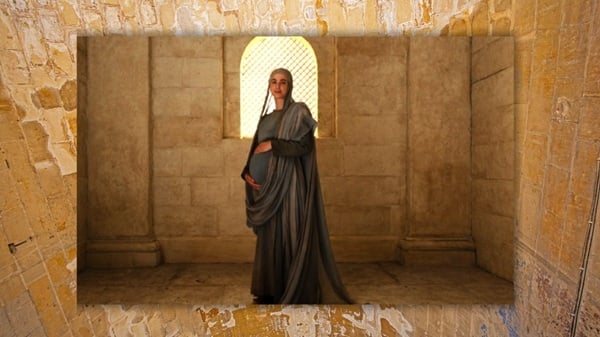
Catholics think about the Virgin Mary all year long, but for most non-Catholic Christians or secular folks, she's mostly just the serene figure in a Christmas-season Nativity scene.
But Fox Nation's Martin Scorsese Presents: The Saints chose to honor the mother of Christ during Holy Week.
Available to stream now, Mary, billed as an extended cut, traces Our Lady's (Bar Misochnik) life from her betrothal to Joseph (Tom Graziani) to the Assumption.
Of all the people around Christ, Mary was the only person present at the moment His life on Earth began, and at the moment it ended.
Talking to Series Creator Matti Leshem About Mary
Last week, I had a chat with Leshem, who also directed the Mary episode and makes an acting appearance as King Herod.
I asked him why, when most of the world considers her a Christmas thing, this Mary episode was scheduled near Easter.
He said:
I think that's really the key. First of all, I think Mary is an always thing.
When we were talking to Jason Klarman, who really sets all the programming for Fox Nation, he had this idea to do a special about Mary for Easter. And it really influenced our thinking.
I was already interested in the idea of seeing aspects of the life of Jesus through His mother's eyes, telling that very personal story of a mother's love.
And when you think about that, the inevitability of how Christ must end His life and how Mary sees that, seemed to be so poignant.
Exploring the Mother-Son Relationship
Mary was not only present for the beginning and end of Christ's Earthly life, she was the one constant throughout it.
Jesus' conception may have been supernatural, but Mary's duties as a mother were much like that of any other woman. He was the Savior of the world, but He was also her little boy.
Said Leshem:
We wanted to tell that story, which is ultimately about her relationship with Jesus.
Most of what we know from the Gospel, certainly, is about the adult life of Jesus and goes towards that inevitable ending.
So we thought it was a perfect time to look at that and also to see the Resurrection through the eyes of a mother.
It's a unique moment of this episode, that scene where you see the resurrected Christ having a very personal moment with the Virgin Mary.
Telling Mary's Gospel Story in a Human Way
While the episode doesn't contradict any Marian doctrines, the dialogue is not always drawn from Scripture. It's a more human dramatization of the story.
Said Leshem:
What we try to do here is to see a very human mother, a very human woman, a woman who is bewildered by her circumstance on the one hand and very accepting of it on another, which I think is part of the paradox of Mary.
The way that we approach Joseph also, bewildered by the circumstance that he finds himself in. And also, these are people of great faith.
That's what's beautiful about it. And I think there is a lot of paradox in faith.
Leshem said people of faith have shown up for the series at Fox Nation, but it's also attracting people who aren't particularly religious.
They might be drawn in by the name Scorsese but also by the way the stories dramatize the lives of saints, or, in this case, a major Biblical figure.
Leshem explained:
Well, we try to make the stories very human because these are real people, right?
Yes, the Gospels have gone through the filter of various translations. They're not strict narratives; they're not film scripts.
We tried to, on the one hand, be true to the Gospels, and yet, in other words, I would say to not disavow the Gospel in any way, but also to add in the pieces where we really don't know, to make these stories [come alive].
I have to tell you, the story of Mary is one that is completely inspiring to me. I try to make it really accessible, I'd say, is the word I'm looking for.
And I think that Catholics, Protestants, Episcopalians, and Baptists can be quite happy with this telling of Mary.
A Jewish Filmmaker Looks at Christ's Jewish Mother
Although Leshem spoke of various types of Christians enjoying the series, he's not one. As he said:
I'm very Jewish.
So, I wanted to know what he thought of this obscure teenage Jewish girl who played one of the most pivotal roles in human history.
He said:
If anything, I've come closer to understanding why Mary is so venerated and why people are so likely to pray directly to Mary.
There's something universal about her motherness that I really understood in exploring this episode.
And so whether or not you believe that Mary is the Mother of God, she definitely seems to be the mother of us all in a way.
There's that universality about her motherness that really spoke to me, and I really understood that. And I don't even mean that like in a Freudian way, but I mean in a kind of an eternal way.
So that, to me, as a Jew -- I know we can make a bunch of bad Jewish jokes about difficult mothers, but not in that way.
She's the ultimate mother in a way. I understood the beauty of that.
So, I can understand if you're going to venerate a saint, or going to venerate someone to intercede on your behalf, I totally understand that.
Leshem's Personal Connection to Mary
There's also something more personal about Mary for Leshem. He said:
I will also tell you that, and I may have told you this story before, but I had a great aunt who converted to Catholicism, who was completely devoted to Mary.
And so I saw that growing up and I was quite taken with it. I think if I had converted to Catholicism, Mary would be my first stop.
Mary's like going to your mom and having a chat, if your mom was a great mother.
Filming the Crucifixion in a Familiar Place
The Mary episode also features the Crucifixion, which was filmed in Matera, Italy.
That's the same location that The Passion of the Christ, and, more recently, The Chosen, used to film their versions of the Crucifixion.
Leshem reveals that they also shot scenes there for an episode on Saint Longinus, the Roman soldier who pierced the side of Jesus with a lance.
In additon, the Mary episode includes a Pietà, a scene of Our Lady cradling Christ after He is taken down from the Cross -- a moment depicted countless times in art.
Leshem recalled:
It wasn't in the script. And when I saw it, I just thought, "You know what, I'm going to shoot it and if it's good enough, we'll put it in. And if it's not, Marty will let me know."
And I shot it, and I loved the moment.
Yes, it is a Pietà moment and yes, it's been done, but the truth is, and this perhaps is a more Jewish perspective, like this is an interpretive art, right? It's like, I want to make that moment real for viewers today.
Yes, you can go and see Bernini's Pietà, other people's Pietà, but here you are watching this on a television show. You've been with the show for 35 minutes, however long it's been, and you're coming to that moment.
And I do think that there's something nice about the recognition of that, but it's also like, you can imagine that the cruelty of that moment where she has to take the body down, and it's put in her lap, and she's able to really express herself in such a beautiful way.
I was very moved by it.
Reprinted with permission from Kate O'Hare's Pax Culturati blog at Patheos.com.
Image: Fox Nation
Kate O’Hare, a longtime entertainment journalist, is Social Media Content Manager and Blog Editor at Family Theater Productions.
ChosenCon 2026: 'The Chosen' Bible Roundtable Priest Reflects
From Netflix to Disney: Has 'Daredevil' Lost Its Soul?
R.I.P. Chuck Norris & Clarence Gilyard: Departed Brothers in Christ
Keep up with Family Theater Productions our website, Facebook, X, Instagram and YouTube.