
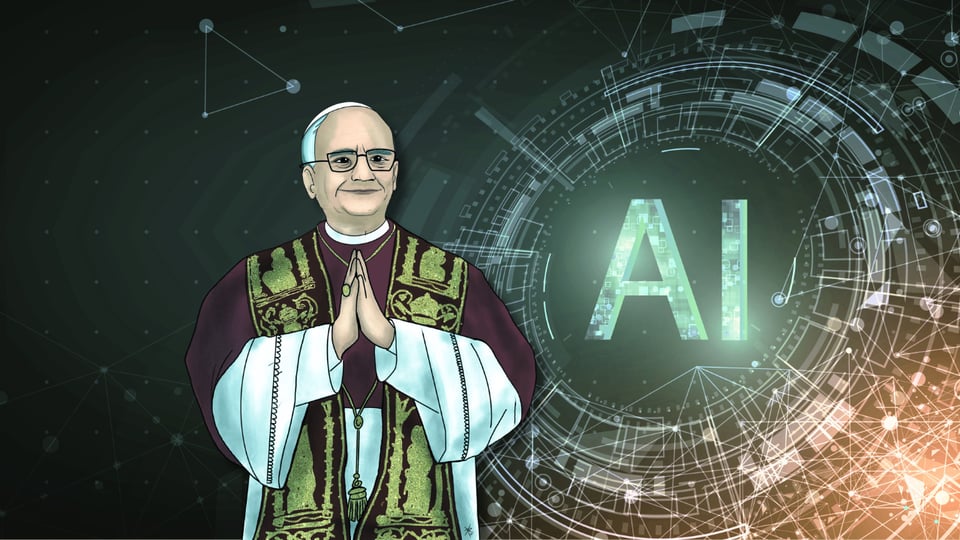
Pope Leo XIV recently released his first encyclical, Magnifica Humanitas, regarding Artificial Intelligence (AI). To say it's caused a stir, both in secular and Catholic media, would be an understatement.
The pope highlighted the promise of the new technology while also warning of the dangers. His encyclical (you can read it here), subtitled ON SAFEGUARDING THE HUMAN PERSON
IN THE TIME OF ARTIFICIAL INTELLIGENCE, reminded me of the must-see documentary, The AI Doc: or How I Became an Apocaloptimist.
I sawthe documentary at its Sundance premiere, and, as its subtitle implies, the film cautions us to welcome the contributions AI makes and will make to our lives, while simultaneously alerting us to its present and potential future perils.
What The AI Doc Says About ... AI
For starters, the AI documentary (available to stream on Peacock and for digital rental/purchase elsewhere) defines how Artificial Intelligence works.
AI collects and retains data … a lot of it … all of it in fact, definitely more than the human brain could hold. AI then recognizes patterns within all of the data and tries to predict the next sequence in the pattern.
So, it appears to be autonomous, like the android in The Terminator franchise, but that’s really not the case. If, for instance, you engage with AI on email writing, AI might write ahead of you, typing out a salutation or your next sentence.
Again, it may appear that AI has a mind of its own, but it’s really just recognizing your history of writing and predicting your next thought.
Within that framework, the most promising future for AI that I took away from the documentary was the benefit for personal health.
Imagine a hypothetical AI body scan that could examine your medical history from literal head to toe. It would absorb and process not only your health history, but the patterns of your health history. AI might accurately predict your next health pattern to be say, a cancerous one, and either provide a very early diagnosis or a path to avoid the disease altogether.
A human doctor does this to an extent in his or her inquiries, gathering medical history from the checklist and asking the simple question in our annual exams: “How’s your health been since I last saw you?”
AI does the same thing with patterns, but much better. The pope, obviously has no problem with AI augmenting human life in this regard.
Pope Leo XIV's Concerns About AI
The most damning indictment of AI that the documentary proposes is the monopoly of it in the hands of the elite and the use of it in warfare.
Pope Leo specifically warns of this, too. Again, AI recognizes patterns. It could recognize the history and patterns between opposing nation states and hypothetically propose the most optimal time to invade a country that would provide the quickest military conquest while limiting deaths.
While I haven’t seen the movie yet, this is essentially the historical record of the new film Pressure. In it, the Allied Powers, led by General Dwight Eisenhower (Brendan Fraser), try to time the D-Day invasion with the most favorable weather.
Humans can do what AI does, but not nearly as well. With AI, though, the pope suggests, nations might be more prone to go to war, rationalizing a hawkish decision by projecting minimal loss of casualties.
Reasons for Hope
Where I think this scientific documentary and the pope’s spiritual reflection converge is a common sense of hope. This only comes after both contemplates the bleakest of outcomes of misusing AI by elites or a single powerful country.
The documentary closes with an image of the atomic bombs from WWII. While nuclear armaments have grown, the filmmakers note the international community has agreed not to use nuclear weapons, as that would in effect, be the end of the human race.
I’m sure Pope Leo would agree with the same sentiment, but he traces history even further back to the Industrial Revolution, the last great technological revolution.
While providing immense benefit and efficiency to our everyday lives, it came at a cost to human workers. Many were overworked and abused, often treated as cogs in a relentless wheel, until law and regulation came into the industries that employed them.
With the speed of AI, we may not have the chance to correct our mistakes this time around.
The pope urges those creating the algorithms to see those using it as children of God, not numbers on bottom lines, or worse, cannon fodder for the next AI-plotted wars.
What's Next?
I know Hollywood filmmakers and Church leadership have been much maligned in recent years. But this documentary is a must-watch, as much as the encyclical is a must-read.
Neither the documentary nor the encyclical is either optimistic or pessimistic about AI, but rather both look at the new technology with realistic eyes, while providing hope.
Humans, for the sake of their own survival, would be keen to watch and to read.
The documentary has also created a website that urges folks to do get involved.
As a bonus, Ascension Press arranged a conversation about Magnifica Humanitas between Father Mike Schmitz and Arthur Brooks, a Catholic author who also teaches at Harvard. Take a look:
Image: Adobe Stock (background image)/Family Theater Productions (pope image)
Father Vince Kuna, C.S.C., is a Holy Cross priest and a 2016 graduate of USC's film school.
'Sacred Heart': An Introduction to the Devotion of Jesus’ Love
Faith & Family News: Gibson's 'Resurrection'; 'Jimmy'; Pope Francis Doc
'The Breadwinner': Cute Kids, Competent Mom, Clueless Dad -- & a Horse
'The Other Bennet Sister' & 4 More Binge-Worthy Shows on BritBox
Keep up with Family Theater Productions our website, Facebook, X, Instagram and YouTube.