
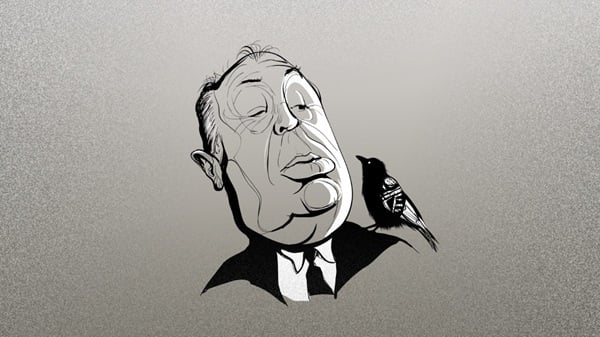
Alfred Hitchcock was a storyteller extraordinaire, but there was also a deeper mystery in his life -- one that took a turn at the end.
When the British-born “Master of Suspense,” as he was called, died in 1980 at the age of 81, he left as repertoire of 53 films, including crime dramas like Rear Window and Dial M for Murder; mysteries like Vertigo and The 39 Steps; and thrillers like North by Northwest and Psycho.
The Spiritual Inner Life of Alfred Hitchcock
Hitch's popularity as a filmmaker was well-known; but less is understood about the spiritual side of his life. The 2012 film Hitchcock, which purported to tell the director's life story, revealed little about his faith, focusing instead on the alleged behind-the-scenes discord with his wife of 54 years, screenwriter Alma Reville.
Two books then purported to tell his life story.
In 2004, biographer Patrick McGilligan published what he termed a “definitive biography” of the film director, Alfred Hitchcock: A Life in Darkness and Light. But while McGilligan did report briefly on the Catholic faith which guided Hitchcock's family of origin, he downplayed its effect in Hitchcock's personal life.
According to McGilligan,
The Hitchcocks were staunchly Catholic, but they showed irreverence for everything, including Catholicism. The Hitchcocks had a number of priests in the family; relatives or not, clergymen were in and out of the home, drinking, singing, laughing, and making mischief.
Twelve years later, in 2016, British novelist and biographer Peter Ackroyd released Alfred Hitchcock: A Brief Life. Ackroyd, too, downplayed the importance of faith. He recounted a story about how Hitchcock kept his feet firmly planted in reality: He smashed a once-used teacup every morning after breakfast, to remind himself of the frailty of life.
Hitchcock's Deep Catholic Roots
But, throughout his youth, Hitchcock was immersed in the Catholic faith. His parents raised him as a Catholic, sending him to a convent school, the Wode Street School “for the daughters of gentlemen and little boys.”
He later attended the Jesuit grammar school at St. Ignatius College in Stamford Hill, London, and was for a short time a boarder at Salesian College in Battersea.
Hitchcock's fiance, Alma Reville, converted to the Catholic faith before their marriage. In 1926, the couple was married in a Catholic ceremony in London's Church of the Immaculate Heart of Mary, more commonly called Brompton Oratory.
Hitchcock and the Jesuit Priests
In Hitchcock's later years, he was often visited at home by two Jesuit priests, Father Tom Sullivan and Father Mark Henninger.
In 2012, Father Henninger wrote an article for The Wall Street Journal about how he, as a young priest from Cleveland studying at UCLA, was invited to accompany his friend Fr. Sullivan to the famed director's house in the Los Angeles enclave of Bel Air.
He wrote,
On that Saturday … when we found Hitchcock asleep in the living room, Tom gently shook him. Hitchcock awoke, looked up and kissed Tom's hand, thanking him.
Father Henninger explained that Hitchcock's extraordinary reaction to receiving Communion revealed the director's real humanity and religious faith, far away from headlines.
He continued,
After we chatted for a while, we all crossed from the living room through a breezeway to his study, and there, with his wife, Alma, we celebrated a quiet Mass.
Across from me were the bound volumes of his movie scripts for “The Birds,” “Psycho,” “North by Northwest” and others –- a great distraction. Hitchcock had been away from the Church for some time, and he answered the responses in Latin the old way. But the most remarkable sight was that after receiving communion, he silently cried, tears rolling down his huge cheeks.
Tom and I returned a number of times, always on Saturday afternoons, sometimes together, but I remember once going by myself. I'm somewhat tongue-tied around famous people and I found it a bit awkward to chit-chat with Alfred Hitchcock, but we did, enjoyably, in his living room. At one point he said, 'Let's have Mass.'
He was 81 years old and had difficulty moving, so I helped him get up and assisted him across the breezeway. As we slowly walked, I felt I had to say something to break the silence, and the best I could come up with was, "Well, Mr. Hitchcock, have you seen any good movies lately?"
He paused and said emphatically, "No, I haven't. When I made movies they were about people, not robots. Robots are boring. Come on, let's have Mass."
He died soon after these visits, and his funeral Mass was at Good Shepherd Catholic Church in Beverly Hills.
Hitchcock found the many changes that followed Vatican II difficult to accept. And, he once turned down the opportunity to meet personally with the pope.
He drifted from the practice of his Catholic faith, no longer attending weekly Mass and participating actively in the sacramental life off the Church.
Nonetheless, Catholicism found its way into his stories. Many of his most popular films –- such as I Confess, Vertigo, Rear Window, Strangers on a Train and others –- employ religious imagery and themes.
Near Its End, Hitchcock's Life Took a Turn Toward the Church
In his Wall Street Journal essay, called "Alfred Hitchcock's Surprise Ending," Father Henninger watched with relief as Hitchcock turned back toward God in his later years.
Reflecting on that embrace of faith, he wrote:
Some people find these late-in-life returns to religion suspect, a sign of weakness or of one's “losing it.” But nothing focuses the mind as much as death. There is a long tradition going back to ancient times of memento mori, remember death. Why? I suspect that in facing death one may at least see soberly, whether clearly or not, truths missed for years, what is finally worth one's attention.
Weighing one's life with its share of wounds suffered and inflicted in such a perspective, and seeking reconciliation with an experienced and forgiving God, strikes me as profoundly human.
Hitchcock's extraordinary reaction to receiving communion was the face of real humanity and religion, far away from headlines … or today's filmmakers and biographers.
Hitchcock films are available to buy, rent or stream on a variety of digital platforms. Check out this guide from JustWatch, and this catalogue from AppleTV.
Image: Shutterstock
Kathy Schiffer writes regularly for the National Catholic Register and Catholic World Report, and for other Catholic publications, including Evangelization and Culture, Crisis Magazine, Aleteia, Zenit, the Michigan Catholic, and Legatus Magazine. She’s worked for Catholic and other Christian ministries since 1988, as radio producer, director of special events, and media-relations coordinator.
Welcoming EWTN's Maria Montserrat Alvarado to a New Vatican Job
'Disclosure Day': Spielberg Tackles Aliens, Secrets and God
AI: A Priest Ponders the Pope's Encyclical (and a Film)
'Sacred Heart': An Introduction to the Devotion of Jesus’ Love
Keep up with Family Theater Productions our website, Facebook, X, Instagram and YouTube.